

Even though the monsoon season has begun, the people of the southern region are not getting any relief. On the contrary, frequent power load shedding amidst intense heat waves and sweltering heat has disrupted public life. Barisal city has been experiencing load shedding for three to four hours every day and night for a week. The amount of load shedding at the district, upazila and village levels is even higher. The common people have been suffering immensely due to the lack of electricity for long periods of time both during the day and at night.
Meanwhile, due to the disruption of ice production due to load shedding, many fishermen in the southern region are facing problems in catching fish in the sea during the current Hilsa season. Due to the uncertainty over fish conservation due to the ice crisis, many trawlers are not able to set sail on time. At the same time, small businesses, shops and various manufacturing-oriented institutions are being affected due to the power crisis. As a result, there has been a slowdown in business and trade, local residents complain.
Amin, a resident of Amir Kutir area of Barisal city, works in an outsourcing company. He said, “Our area does not have electricity for an average of four to five hours a day and night. It is extremely hot, and all our work depends on electricity. Due to unbearable load shedding, income has decreased due to disruption of one work, while on the other hand, life has become unbearable due to the intense heat.”
The power shortage has also had a huge impact on the heavy, medium and small industries of Barisal, including the BSCIC industrial area of the city. Due to frequent load shedding, production in these industries has collapsed. At the same time, there has been a disaster in the poultry and other industrial sectors.
Supply is less than demand.
The Western Power Distribution Corporation (OJOPADICO) supplies electricity to the six district headquarters of Barisal division. There are about five lakh customers in the six district towns under this organization. Of these, the number of customers in Barisal city is more than 150,000. On the other hand, the Palli Bidyut Samity (PBIS) supplies electricity to the upazila headquarters and union levels. There are about 21 lakh 65 thousand customers under the five PBIS of the division.
According to sources from the Barisal National Grid Sub-Center, the daily electricity demand in the Barisal, Bhola, Patuakhali, Jhalokati, Barguna and Pirojpur districts of the division is 550 to 600 megawatts. About 400 megawatts are available there.
Executive Engineer of Power Grid Substation Barisal Md. Aktaruzzaman Palash told Prothom Alo on Wednesday afternoon, ‘The demand for electricity fluctuates during peak and off-peak hours. However, currently, 25 to 30 percent of our demand is being met by less electricity. For this, it is being adjusted by load shedding.’ He further said that in view of the real situation, the distribution authority adjusts electricity by reducing load shedding in more important areas including industrial areas. Therefore, the level of load shedding at the consumer level may seem more or less.
Ojopadiko has two distribution divisions in Barisal city. Of these, the daily electricity demand in Distribution Division-1 is 90 megawatts. But it is receiving 50 megawatts. Manjul Kumar Swarnakar, executive engineer of Distribution Division-1, told Prothom Alo on Wednesday afternoon that half the electricity is currently being received compared to the demand. This situation has been going on for a week. For this, load shedding has to be done in shifts of three to four hours day and night.
On the other hand, Executive Engineer of Distribution Division-2 Md. Manjurul Islam told Prothom Alo, ‘For several days, there has been a shortage of electricity as per demand. We are getting 20 to 22 MW of demand of 40 MW. So we have to adjust by load shedding for 8 to 9 hours day and night.’ Asked why less electricity is being available compared to demand, he said, ‘Generation is decreasing. That is why there is a shortage.’
The situation is even worse in the villages.
People in rural areas are suffering the most from the power crisis. Customers complain that the situation in upazilas and villages under rural electricity is more precarious than in cities. In many areas, there is no electricity for four to five hours a day and night, and in some places even more. People’s lives have become miserable as they have to spend long periods without electricity amid intense heat and sweltering weather.
Anwar Hossain, a resident of Kalibari village in Patharghata upazila of Barguna, said on Wednesday afternoon, “Our area has electricity for an average of four to five hours a day. The rest of the time, there is no electricity. There is no specific time when it will come or go. Life has become unbearable in this heat.”
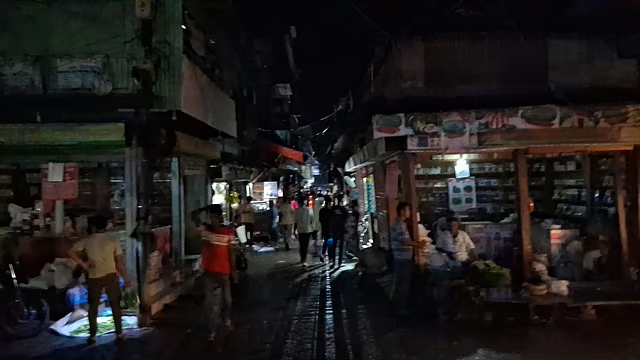
Barisal city plunged into darkness on Wednesday night due to sudden load shedding.Photo: Prothom Alo
Although some residents of Patharghata municipality have spoken of relative relief, the situation there is not normal either. Akhiruzzaman, a resident of the municipality, said, “There is no electricity for six to seven hours a day and night. I am very worried about small children, the elderly and the sick in the heat. Life has become miserable.”
Badal Mridha, a television and mobile phone repairer in Botra Bazar, Biharipur village, Bakerganj upazila of Barisal, expressed his anger and said, “There is no electricity for most of the day. This has led to a decline in business and commerce. Life has become unbearable due to the intense heat. Even when I call the electricity office, no one picks up. However, I have to pay the bill regularly at the end of the month.”Read more
‘I bought a TV on credit, but I can’t watch any games without electricity’
Local residents said that due to frequent load shedding, not only normal life is being disrupted, but also small businesses, students’ studies, and agricultural and irrigation activities are being affected. The suffering of children, the elderly, and the sick is increasing several times due to the prolonged lack of electricity, especially at night. Daily work plans are also being disrupted due to the lack of any fixed schedule for load shedding.
Fishermen unable to go to sea due to ice crisis
The southern fishing sector is facing a crisis due to frequent load shedding. The 58-day ban on fishing in the sea has already ended and the Hilsa season has begun. But due to the power crisis, production in ice factories has been disrupted, and trawler owners are not getting ice as per demand. Moreover, the quality of the ice that is being produced is also not satisfactory. As a result, hundreds of thousands of sea-going fishermen and fish traders are in extreme uncertainty.
Talking to ice factory owners, it has been learned that 12 to 14 hours of uninterrupted electricity is required to produce a block of ice. But due to load shedding every two to three hours, the process of freezing ice is being repeatedly disrupted. As a result, it takes almost twice as long to produce ice as usual. This has not only increased the cost of production, but also reduced the quality of the ice produced.
The biggest impact of the ice crisis has been on coastal fishing ports. The country’s second largest fishing port run by the Bangladesh Fisheries Development Corporation (BFDC) at Patharghata in Barguna, Alipur and Mahipur in Patuakhali, and various fish landing centers in Bhola require a huge amount of ice every day. But the current production is much less than that demand. As a result, many trawlers are unable to go to sea on time due to lack of ice.
According to the Fisheries Department, there are about 90 private ice factories in Patharghata alone. On the other hand, there are at least 40 ice factories in the Mahipur and Alipur areas. Most of these factories are currently unable to produce at full capacity due to power shortages.
Md. Sohag, manager of ME Ice Factory in Patharghata, told Prothom Alo, “The demand for ice is the highest now. The hilsa season has started. But due to lack of electricity, even 30 percent of the demand for ice cannot be supplied. Due to lack of uninterrupted electricity, water does not freeze properly. This increases the cost of production and the quality of the ice is not good. It melts quickly.”
Gazi Majnu, owner of Gazi Ice Plant in Kalapara and a fish trader, said, “The ice crisis is severe now. Without ice, how will fishermen go to sea with trawlers? I can’t even say when the situation will return to normal.”
Fishermen said that a trawler usually catches fish in the sea for seven days or more. During this time, the fish caught is kept in ice in the storage room of the trawler. But the ice that is currently available is melting quickly. This situation has arisen because the ice is not freezing properly due to power outages. As a result, it is becoming increasingly difficult to preserve fish in the sea and maintain the quality of the fish.
Fishermen Afzal Hossain and Habibur Rahman, who are waiting for the trawler at the Patharghata fish landing center, told Prothom Alo on Wednesday that they are waiting for ice with their bags. It is not certain when they will get it. All preparations to go to sea with the trawler are complete, but the journey is not possible without ice.


