

The US-Iran ceasefire deal has become a political nightmare for Israeli Prime Minister Benjamin Netanyahu, shattering three of the cornerstones of his political career and plunging him into a new security crisis.
How could a man who presented himself as a political advisor to Washington and who was thought to have real influence over American politicians be so ignored and so publicly humiliated by his main American ally?
How does the man who made confronting Iran central to Israel’s security strategy end the war in a situation where many believe Iran has become stronger than ever?
And his long-standing political identity as Israel’s “Mr. Security” is already in question. How will his image survive if Israel is forced to halt its campaign against Hezbollah in Lebanon under pressure from the United States and Iran, months before Israel’s general elections?
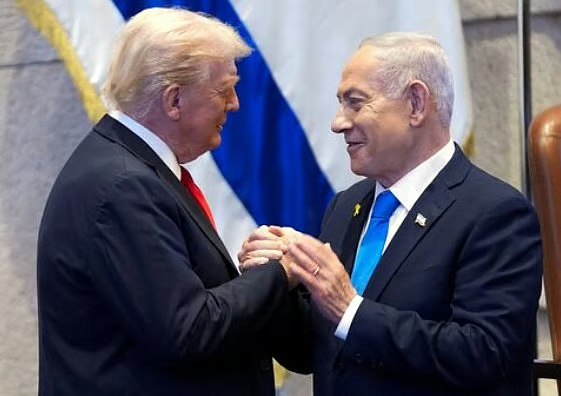
Analysts believe that a rift has appeared in the love affair between US President Donald Trump and Israeli Prime Minister Benjamin Netanyahu.File photo: Reuters
The options open to Netanyahu now are not pleasant. Israel’s opposition leader Yair Lapid outlined them in the Knesset (parliament) on Monday: either enter into direct and destructive conflict with Israel’s greatest ally (the United States) or surrender Israel’s interests.
US President Donald Trump’s scathing assessment that Netanyahu showed no consideration when ordering the Beirut attack last Sunday has already been seized upon by his political opponents and media analysts, who are already bringing it up ahead of the elections due by the end of October.
At the same time, statements by members of Netanyahu’s own Likud party and hardline ministers in the ruling coalition government led by him have also made it clear that the Israeli prime minister is under pressure from within his own camp. In particular, Israeli hardliners have reacted strongly to Tehran’s claim that the peace agreement with the United States includes a cessation of military operations everywhere, including Lebanon.
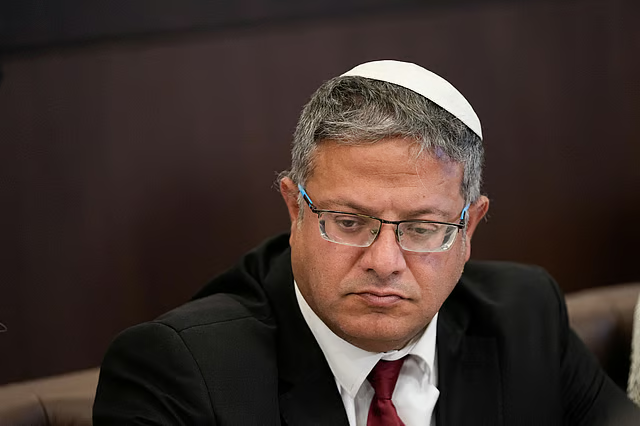
Israeli National Security Minister Itamar Ben-GavirFile photo: Reuters
Israel’s hardline National Security Minister Itamar Ben-Gavir wrote on social media yesterday, “We are not obligated to accept Trump’s deal. We are not parties to this deal, which does not guarantee our security.”
Likud Party MP Ariel Kalner told the BBC that “Israel will defend itself.” However, he did not clarify whether this meant that Israel would continue to attack.
“We will do what we need to do,” the leader of Netanyahu’s party said. “We hope our friends will understand us.” He added that sometimes differences can arise between allies and allies should understand their allies when they are in danger.
Sima Shinay, a former Mossad officer and Iran expert, said it was hard to understand why the Americans would accept this. By giving Iran the power to determine what happens in Lebanon, the United States is allowing Iran to continue supporting Hezbollah. At the same time, Hezbollah is being confirmed as a major political force in the Lebanese arena. Israel is not happy about this, she said, whether for security or political reasons.
The Israeli prime minister himself has so far remained silent amid the intense outcry and anger from across the political spectrum. Usually quick to take credit for any success, his silence is seen by many as an indication of the difficult situation he faces in determining his next steps.
Security has been at the heart of Netanyahu’s promises to voters for decades, but it’s becoming increasingly difficult for him to deliver that message.
Netanyahu’s response to the Hamas-led attack on October 7, 2023, was to shift Israel’s security policy to a more aggressive path—adopting a strategy of preempting potential threats rather than containing them after they arise.
Netanyahu saw the solution to the crisis as transforming the Middle East by eliminating the threats facing Israel.
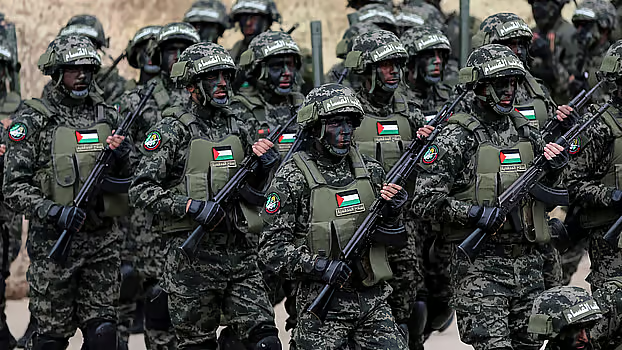
The Palestinian independence movement Hamas still controls about half of the Gaza Strip.File photo: Reuters
But while Israeli forces have destroyed much of the Gaza Strip and killed more than 73,000 people, Hamas still controls about half of the territory and is trying to reassert its authority there. Moreover, eight months after Israel and Hamas agreed to a ceasefire, the proposed US-brokered peace plan and the US-appointed administration for Gaza remain in limbo.
Netanyahu’s new security strategy has left Israeli forces occupying large swaths of Gaza, Lebanon and Syria. Many Israelis welcome the occupation, and it is unlikely to end before the election. But it is also putting a strain on Israel’s military capabilities and reserves. There is no clear diplomatic path out of the situation.
Despite repeated clashes with Hezbollah and the Iranian regime, Israel’s main adversaries have not been eliminated; rather, power in Tehran has passed into the hands of more hardline leaders who fear US-Israeli military power less than before and have gained greater strategic advantage through influence in the Strait of Hormuz.
The current situation is such that Israel’s arch-rival is seen as having a dominant position over Israel’s main ally.
Danny Citrinovich, a senior Iran researcher at Israel’s Institute for National Security Studies (INSS), said Israel’s failure highlights the need to reassess its strategy towards Tehran. He said Israel needs to set more realistic and restrained priorities.
Danny Citrinovich writes in the newspaper Israel Hayom that any move by the Israeli military is seen in Washington as an attempt to sabotage the deal. This could lead to a harsh response from the US. During the Obama administration, Benjamin Netanyahu tried to bypass the White House by garnering support from Congress and the US public, but now he no longer has that opportunity.


