

Indian Prime Minister Narendra Modi met with President Trump on the sidelines of the G7 summit on Wednesday, just a week after three Indian sailors aboard a commercial ship were killed in a US attack, putting further strain on relations between the two countries.
Modi may want to stabilize this relationship. But his task is quite difficult. India is now quite weak due to the Iran war. And yet this war was started by the US. The Trump administration is largely indifferent to the impact of the war on India.
Trump imposed punitive tariffs on India last August for buying oil from Russia. Since then, India has been struggling to find alternative sources of oil. On top of that, India is now facing a major energy crisis due to new restrictions on oil supplies from the Gulf region. The long-awaited trade deal is still hanging in the balance.
The deaths of Indian sailors in the Gulf of Oman have dealt a major blow to hopes of repairing relations between the two countries.
This is the first face-to-face meeting between the two leaders since February 2025. However, the two leaders were not seen meeting this time. Before the meeting, Modi extended his hand once at the summit, but Trump did not shake it. Modi went to Washington to congratulate Trump after he came to power for a second term. At that time, there was a lot of warmth between them.
The situation has changed in the last 16 months. Trump’s volatile and sometimes aggressive behavior has led to major changes in the relationship between the two countries. The Trump administration is pushing to open up India’s market; it has also adopted immigration policies that have had a major impact on Indian students and workers in the United States.
These actions against India’s interests have damaged the country’s economy. It has also tarnished India’s national prestige. Questions have been raised about the benefits of the personal friendship between the two leaders.
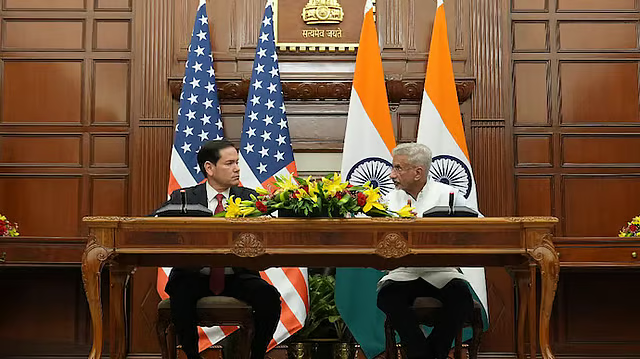
US Secretary of State Marco Rubio and Indian External Affairs Minister S Jaishankar discussed the incident of the US attack on an oil tanker that killed three Indian sailors.File photo: Reuters
“The closeness that has developed between Delhi and Washington over the past 25 years is now in a precarious state. The paths of the two countries could even diverge,” said Atul Keshap, president of the US-India Business Council and a former US diplomat in India.
Atul Keshav also said that the two governments should strengthen areas of common interest such as the digital economy and nuclear energy instead of endlessly negotiating trade agreements.
India took a tough stance on trade deals after Trump imposed tariffs on several countries last year. The lengthy negotiations have also frustrated US officials.
However, a mineral resources agreement was recently signed during Secretary of State Marco Rubio’s visit to India, indicating some efforts to rebuild relations.
A senior official, who did not wish to be named, said Trump and Modi met on Wednesday morning. They discussed various issues, including a trade deal that had been pending for a year.
The two countries finalized a draft of an interim trade agreement in February. However, negotiations are still ongoing on the terms. It is not clear when the agreement will be signed. According to the official, the possibility of the agreement being finalized at the G-7 meeting was low.
Narendra Modi did not even nominate Trump for the Nobel Peace Prize. There is tension between the two sides over this.
According to analysts, India should swallow its pride and be flexible because it does not have the same strong influence in the global economy as China or the United States.
“India’s most important relationship is with the United States,” said Aparna Pandey, a senior fellow at the Washington-based Hudson Institute.
Last week, US forces launched missile attacks on three oil tankers in the Gulf of Oman, killing three Indian sailors and rescuing several others. The US claims the ships were violating a naval blockade imposed on Iran.
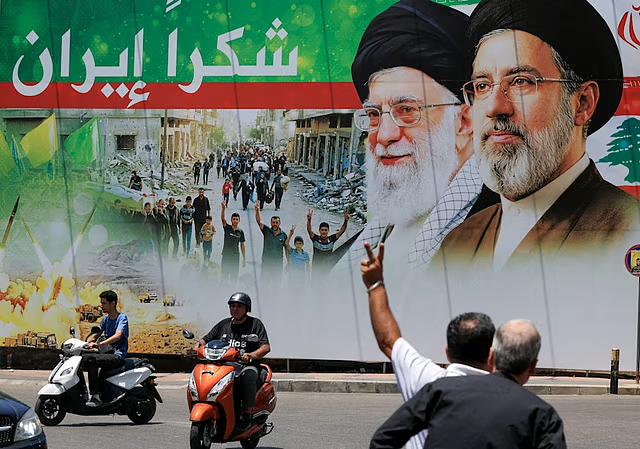
A man shows a victory sign as he walks past a banner reading ‘Thank you Iran’. Beirut’s southern suburbs, Lebanon. June 15, 2026.Photo: Reuters
The attack has sparked widespread outrage in India, with criticism of the US military for putting the lives of other Indian sailors on board at risk. The Indian government has lodged a “strong protest” with the US diplomat in Delhi. However, the opposition alleges that the government is not taking enough action.
Leader of the Opposition in the Lok Sabha Rahul Gandhi criticised Modi’s silence, calling him a “loyal servant” of Trump.
Despite growing bitterness over trade and politics, the dramatic friendship between the two leaders remains intact. Both want to be known as “strong leaders.” Last week, Trump congratulated Modi on becoming India’s longest-serving prime minister. “And he is truly a great leader,” Trump wrote on Truth Social.
During a meeting held on the sidelines of the G-7 summit, Trump praised Indian Prime Minister Narendra Modi, calling him both an ‘angel’ and a ‘killer’ (a tough or metaphorical player in trade negotiations).
Trump made the comment, referring to the difficult negotiations that have been going on for a long year between the two countries and the fact that no final trade agreement has yet been reached.
Modi has also expressed gratitude to Trump. However, their behind-the-scenes relationship has been tense. Trump left early during the G-7 summit in Canada last June. As a result, the two leaders did not meet in person, but spoke only by phone. Modi later did not accept an invitation to visit Washington. India is not a member of the G-7, but regularly participates in the summit as an invited country.


