

Public confidence in the value of a university degree has fallen significantly in the UK, with nearly a third of people in the country believing that a university degree is not a good investment of time and money, a new survey has found.
According to the British Social Attitudes (BSA) survey, in 2005, only 14 percent of people believed that earning a degree was not worth the time and money, but in 2025 that number had risen to 34 percent. At the same time, the number of people who believed that going to university would be more financially rewarding has fallen from 50 percent to 36 percent.
Increased number of degree holders and competition
Experts say that increased competition for employment for graduates, the burden of debt, and uncertainty in the job market due to artificial intelligence are playing a significant role in this change.
Higher education in the UK has expanded significantly over the past few decades. In 1983, only 6 percent of students went on to university after leaving secondary school. Today, this rate has risen to 36 percent, and there are more than two million students studying in higher education in the country.Read more
SSC and equivalent exam results 2026 July 20
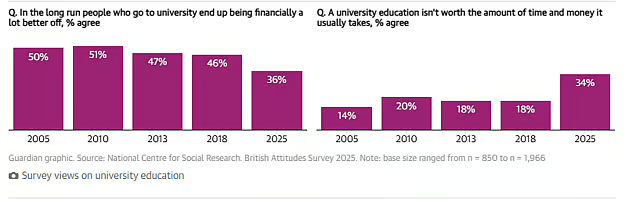
Photo: Collected
High tuition fees and debt pressure
Meanwhile, the cost of education has also increased significantly. When tuition fees were introduced in 1998, the annual fee was £1,000. Currently, students in England have to pay a maximum of £9,535 in tuition fees per year, as well as accommodation and living expenses.
The survey found that frustration with higher education is relatively high among those who attended university under the tuition fee system. The income limit for student loan repayment has long been fixed without adjusting for inflation, which is creating additional pressure on borrowers.Read more
How to get a German student visa
Is a degree still profitable?
But university sector representatives are still pushing the long-term benefits of higher education. Vivian Stern, chief executive of Universities UK, said people with degrees generally have better job prospects, earn more and are in better health. She said the country also needs skilled graduates to grow its economy.
Nick Hillman, director of the Higher Education Policy Institute, said that the expected financial benefits of a university education are not always available due to slowing economic growth. However, the majority of people still do not completely deny the value of a university education.

AI/Prothom Alo
Negative experiences of students
Alex Stanley, vice-president of higher education at the National Union of Students, said his university education had given him valuable experience and opportunities. However, working three jobs alongside his studies had affected his results. He currently has more than £50,000 in student loans, which are rising despite regular repayments.


